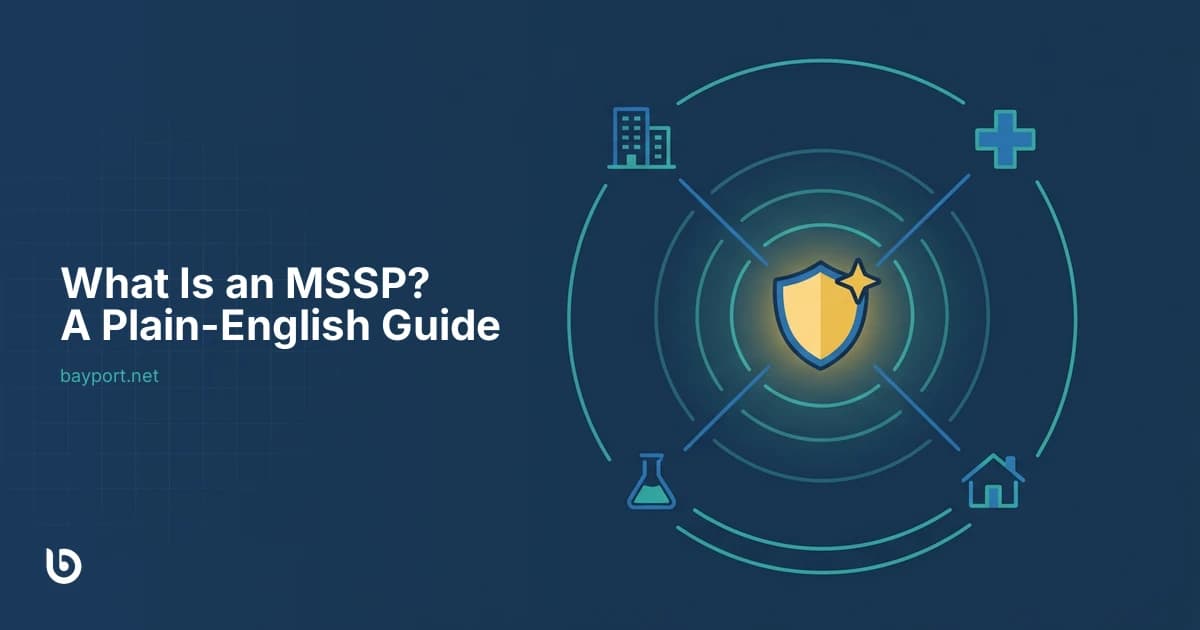
What Is an MSSP and Does Your Business Need One?
If you run a business that handles sensitive data — customer information, financial records, health data, intellectual property — you've probably heard the term "MSSP" come up in conversations about security. But what does it actually mean, and how is it different from the IT company you already work with?
MSP vs. MSSP: The Difference in Plain English
An MSP (Managed Service Provider) manages your IT infrastructure. They handle your network, servers, email, help desk tickets, and day-to-day technology operations. They keep things running.
An MSSP (Managed Security Service Provider) manages your security. They monitor for threats, detect attacks, respond to incidents, and help you maintain compliance. They keep things safe.
Think of it this way: your MSP makes sure your email works. Your MSSP makes sure nobody is reading your email who shouldn't be.
Some organizations provide both services. Others specialize. The important thing is that security management is a distinct discipline from IT management — it requires different tools, different expertise, and often 24/7 monitoring capabilities that most MSPs don't offer.
What an MSSP Actually Does
A typical MSSP provides:
- 24/7 monitoring: Human analysts at a Security Operations Center (SOC) watch your environment around the clock for suspicious activity
- Threat detection: Advanced endpoint protection that identifies and contains threats that traditional antivirus misses
- Incident response: When something does happen, coordinated triage and remediation by people who already know your environment
- Compliance support: Documentation, evidence packages, and reporting that satisfy auditors and insurance underwriters
- Security operations: MFA deployment, patch management, access control policies, and security awareness training
Signs Your Business Needs an MSSP
Not every business needs dedicated security management — but more do than realize it. Here are the signs:
- You're growing. More employees, more devices, more data. The attack surface expands with every new hire and every new application.
- You handle sensitive data. Customer PII, patient records, financial information, intellectual property. If a breach would trigger notification requirements, you need monitoring.
- Your insurer is asking questions. Cyber insurance applications now require specific controls — MFA, EDR, incident response plans. An MSSP implements and documents these.
- You've had a scare. A phishing email that almost worked. A ransomware attempt that was caught late. A vendor breach that exposed your data. Near-misses are warnings.
- You can't hire a security team. A full-time CISO costs $200,000–$400,000. A security analyst costs $120,000+. An MSSP gives you a team for a fraction of that.
What to Look For in an MSSP
Not all MSSPs are created equal. When evaluating providers, ask:
- Is the SOC human-led or just automated alerts? Automated alerts without human analysis create noise, not security. Look for a SOC with human analysts.
- Do you get a named team or a ticket queue? The people managing your security should know your environment, not be looking at it for the first time during an incident.
- Does it support compliance? If you need HIPAA, SOC 2, or CCPA compliance evidence, make sure the MSSP generates it as part of the service.
- Overlay or rip-and-replace?Some MSSPs require you to switch your entire IT stack to their platform. Others layer security on top of what you already have. The overlay model is less disruptive and doesn't force you to fire your current IT provider.
Why Bay Area Businesses in Particular
Bay Area businesses face a unique combination of pressures. California has the strictest privacy regulations in the country. The region is home to high-value targets in biotech, finance, and technology. Security talent is expensive and hard to retain.
An MSSP based in the Bay Area understands these pressures. They know the regulatory landscape, they know the threat environment, and they can meet in person when the situation calls for it.
The Bottom Line
An MSSP isn't a luxury — it's the practical answer to a real problem. Most midsize businesses can't afford a security team, but they can't afford to go without security either. A managed security service gives you 24/7 protection, compliance support, and a named team — at a fraction of the cost of building it in-house.