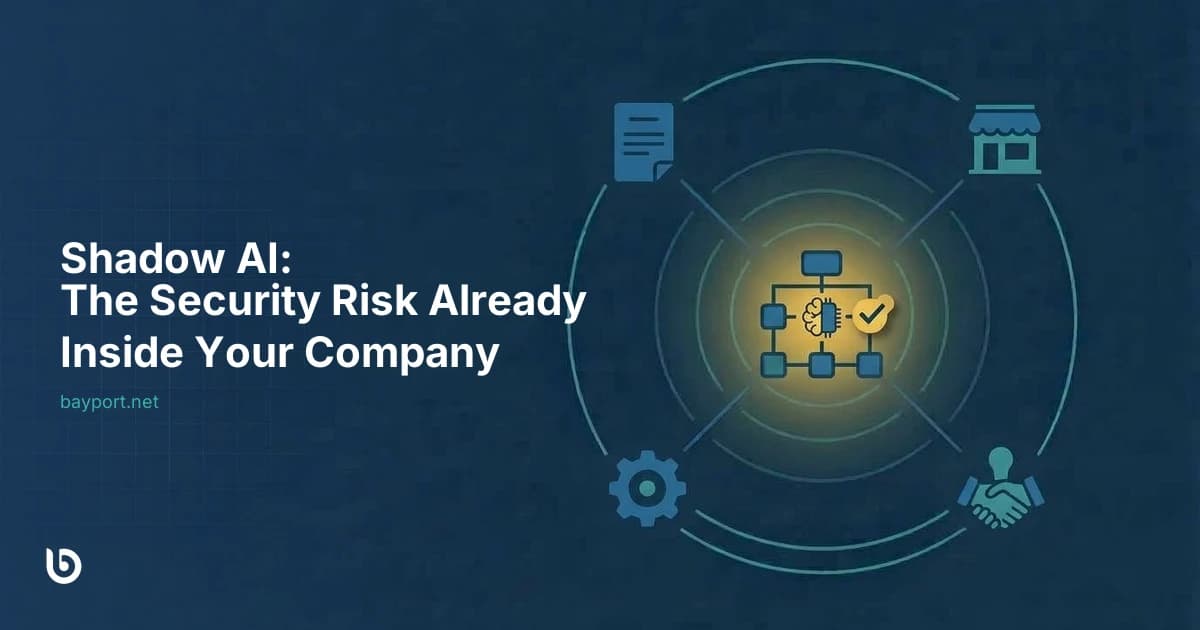
Shadow AI: The Security Risk Your Team Isn't Talking About
Your employees are using AI tools at work. The question isn't whether — it's how much, and with what data. According to industry surveys, the majority of knowledge workers now use generative AI tools at least weekly, and most organizations have no formal policy governing their use.
This is shadow AI — the use of AI tools like ChatGPT, Claude, Microsoft Copilot, Gemini, and dozens of specialized AI applications with company data, without explicit authorization or security review. It's the fastest-growing security blind spot in 2026.
Why Shadow AI Is Dangerous
Shadow AI creates risk in ways that are different from traditional shadow IT:
- Data leakage:When an employee pastes a client contract into ChatGPT to summarize it, that data may be used to train the model or stored on third-party servers. The employee didn't mean to create a data breach — but the effect is the same.
- Compliance violations: If your business is subject to HIPAA, SOC 2, or CCPA, feeding regulated data into unapproved AI tools may violate your compliance obligations — even if the output looks fine.
- No audit trail:When decisions are made with AI assistance, but the AI usage isn't logged or documented, you've lost accountability. If something goes wrong, you can't trace how the decision was made.
- Intellectual property exposure: Code, product designs, financial models, and strategic documents uploaded to AI tools become data that you no longer fully control.
How It Happens in Practice
Shadow AI doesn't look like a security incident — it looks like productivity. Here are scenarios we encounter regularly:
- A paralegal pastes a client agreement into an AI tool to identify key terms and obligations. The agreement contains confidential business terms and personally identifiable information.
- A finance team member uploads a quarterly financial summary to get help building a board presentation. The financials include unreported revenue figures.
- A developer uses an AI coding assistant with access to proprietary source code. The code includes API keys, database connection strings, and business logic.
- An HR manager uses AI to draft employee communications and performance reviews, inputting employee names, compensation data, and performance details.
In each case, the employee is trying to work faster and smarter. Nobody is being malicious. But the data is now outside your control.
What a Shadow AI Assessment Looks Like
A shadow AI assessment identifies what AI tools your organization is actually using, what data is flowing into them, and where the risks are. The process typically includes:
- Discovery — cataloging every AI tool in use across the organization, authorized or not, through network analysis, SSO logs, browser extension audits, and employee interviews
- Risk evaluation — assessing each tool's data handling practices, terms of service, and security posture
- Data flow mapping — identifying what types of company data are being sent to each tool
- Gap analysis — comparing current usage against compliance requirements and security best practices
- Governance roadmap — recommendations for which tools to approve, which to restrict, and what policies to implement
Building an AI Acceptable Use Policy
The goal isn't to ban AI — it's to govern it. An effective AI acceptable use policy should cover:
- Which AI tools are approved for use and for what purposes
- What types of data can and cannot be input into AI tools (specifically: no PII, no client data, no financials, no source code without approval)
- Requirements for new AI tool requests — who approves them and what security review is needed
- Logging and accountability — how AI-assisted work is documented
- Training requirements — ensuring every employee understands the policy and why it matters
The Bottom Line
Shadow AI isn't going away. AI tools are too useful, and employees will find ways to use them whether you have a policy or not. The question is whether you have visibility and governance — or whether you're flying blind.
The organizations that get this right will use AI as a competitive advantage. The ones that ignore it will learn about their exposure the hard way — from a breach notification, an audit finding, or a client who discovers their data was processed through an unauthorized AI tool.