AI Governance for Small Business: What You Need Before Your Next Audit
What AI Governance Actually Means
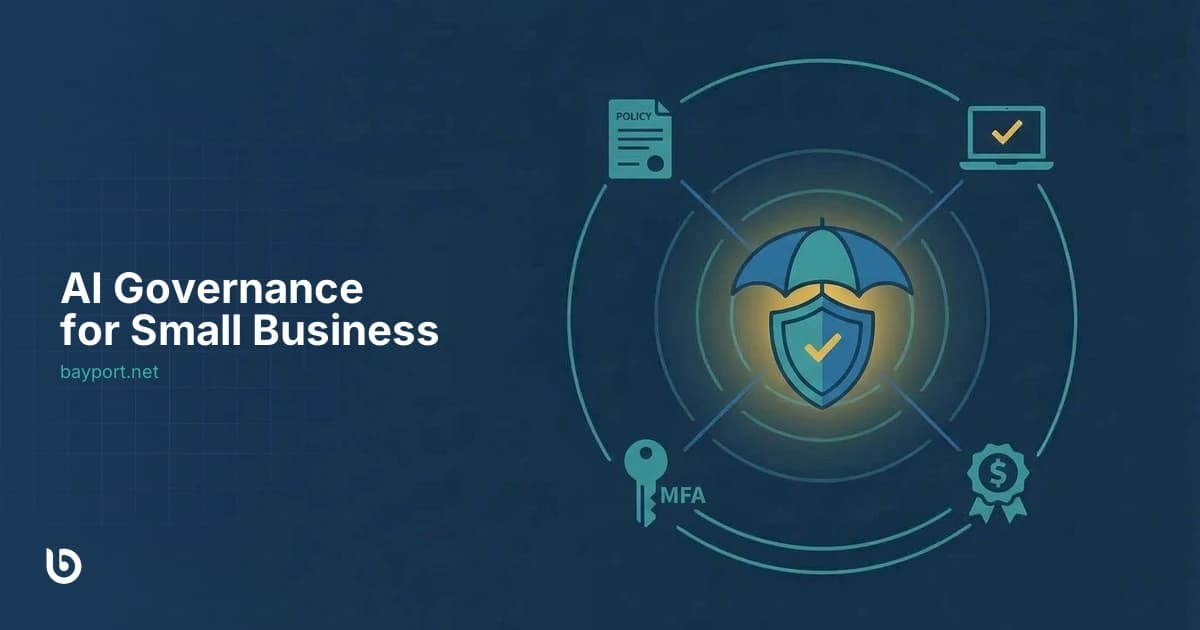
AI governance is not about banning AI tools. It is about knowing what tools your team is using, what data is flowing into them, and having written policies that define acceptable use. For a small or midsize business, this means three things: an approved tools list, a data classification policy, and an AI acceptable use policy. That is it. You do not need a dedicated AI ethics board or a machine learning engineer. You need documentation and awareness.
Why It Matters Now
Three forces are converging. First, shadow AI is already happening — employees are using ChatGPT, Claude, Copilot, and other tools with company data, often without authorization. A 2025 industry survey found that the majority of knowledge workers use generative AI weekly, but fewer than half of organizations have a formal AI policy. Second, regulators are paying attention. California's CCPA amendments include provisions for businesses using AI to process personal information, and the EU AI Act is setting global precedent. Third, cyber insurance carriers are starting to ask about AI use in underwriting questionnaires. If you cannot document your AI governance practices, it may affect your coverage.
The Three Things Every Business Should Document
1. Approved tools list — Which AI tools are authorized for use, and for what purposes. This is not about being restrictive, it is about being deliberate. List each approved tool, what it can be used for, and what data categories are allowed.
2. Data classification policy — Define what data can and cannot be input into AI tools. At minimum: no personally identifiable information, no client data, no financial records, no source code without explicit approval.
3. AI acceptable use policy — A clear document that every employee reads and acknowledges. It should cover approved tools, prohibited data inputs, how to request new tools, and consequences for violations.
How This Connects to Security
Every AI risk is a data security risk. When an employee pastes a client contract into an AI tool, that is a data leakage event. When someone uploads financial models for AI analysis, that is a potential compliance violation. When AI-generated code includes hardcoded credentials, that is a vulnerability. Your security team — whether internal or a managed security provider — is the natural owner of AI governance because they already manage data protection, access controls, and compliance documentation.
What a Shadow AI Assessment Looks Like
If you are not sure what AI tools your team is already using, start with a shadow AI assessment. The process catalogs every AI tool in use across your organization through network analysis, SSO logs, browser extension audits, and employee interviews. It evaluates each tool's data handling practices and security posture, maps data flows, and delivers a governance roadmap with prioritized recommendations. Most assessments take 2 to 4 weeks and result in a written report plus an AI acceptable use policy your team can adopt immediately.
The Bottom Line
AI governance is not optional and it is not complicated. Document your approved tools, classify your data, write an acceptable use policy, and make sure your employees know about it. If you already have a managed security provider, ask them about AI governance — the best ones can handle both. If you do not, this is a good time to start that conversation.